(This article was AI-generated. Please contact us at liyanguo@nbu.edu.cn if you notice any errors)
Professor Huang Shaohua's team published a research paper titled "Chirality-dependent interaction between zein and dihydromyricetin isomers: binding mechanism and gastrointestinal behaviour" in Food Research International, revealing the chiral-dependent interaction mechanism between zein and dihydromyricetin isomers and their digestion behavior in the gastrointestinal tract. Polyphenol-protein interactions play a crucial role in determining the physicochemical and functional properties of plant-based foods. These interactions often induce changes in proteins, enhancing emulsification and solubility. Dihydromyricetin (DMY), a natural dihydroflavonoid, possesses various health benefits such as antioxidant and anti-tumor properties. However, its poor water solubility and low bioavailability limit its applications. Zein, with its safety and abundant hydrophobic domains, serves as an ideal carrier for delivering bioactive components in food systems.
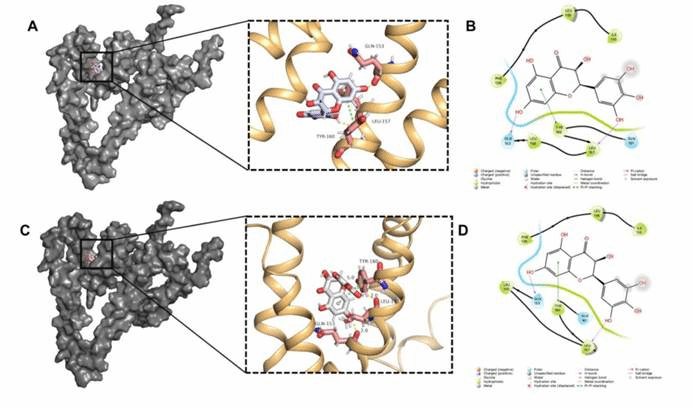
Figure 1. Molecular docking visualization reveals the interactions between dihydromyricetin of different configurations and zein.
This study focused on the chiral characteristics of DMY, and for the first time, investigated the interaction differences between (2R, 3R)-DMY, (2S, 3S)-DMY, and the racemate (rac-DMY) with zein. Using various characterization techniques such as fluorescence spectroscopy, circular dichroism spectroscopy, and Fourier transform infrared spectroscopy, combined with molecular dynamics simulations and in vitro gastrointestinal digestion models, it was found that the chiral configuration of DMY is a key factor affecting its binding ability to zein. Molecular dynamics and in vitro digestion experiments validated that the Zein-(2R, 3R)-DMY complex exhibits superior thermodynamic stability and targeted sustained-release capabilities, outperforming the complexes formed by (2S, 3S)-DMY and rac-DMY with zein. This reveals the regulatory role of the chiral characteristics of polyphenolic compounds on their interactions with proteins, subsequent digestion behavior, and functional activities. The study provides new insights for designing functional food delivery systems based on chiral polyphenol-protein complexes. This work was supported by the National Natural Science Foundation of China (Grant Nos. 32502106, 22174080).
Original article link: https://doi.org/10.1016/j.foodres.2025.117901

