(This article was AI-generated. Please contact us at liyanguo@nbu.edu.cn if you notice any errors)
The Ni Feng team at the Ningbo University Institute of Drug Discovery Technology is dedicated to developing chemoproteomics technologies and promoting their applications in biomedicine and life health fields. In October 2024, the research group, in collaboration with Professor Zhu Feng's team at Zhejiang University, published a research article titled "Chem(Pro)²: the atlas of chemoproteomic probes labelling human proteins" in Nucleic Acids Research (IF=16.6), officially launching the chemoproteomics database Chem(Pro)² for free global use at: https://idrblab.org/chemprosquare/
Chemoproteomic probes (CPPs) are powerful molecular tools that have been successfully applied across multiple areas of drug development, including identification of drug off-targets, lead compound screening in early drug discovery, and optimization of the efficacy and specificity of known lead compounds. However, CPP design still faces tremendous challenges, and comprehensive analysis based on large-scale probe data would provide significant assistance. Furthermore, collecting big data on CPPs is crucial for facilitating AI-based learning of intermolecular interaction patterns to discover innovative targets and drugs.
Currently, multiple databases provide information on compound-protein interactions, including BindingDB, ChEMBL, CovPDB, GtoPdb, KLIFS, Chemical Probes Portal, and CovalentInDB. However, only one database called CysDB is currently available for describing CPP data, primarily focusing on providing information about three CPP probes that covalently bind to cysteine sites on 1,621 human proteins. Nevertheless, besides cysteine, multiple amino acids can be covalently labeled, including lysine, tyrosine, aspartic acid, glutamic acid, histidine, tryptophan, and methionine. Additionally, photoaffinity probes represent another widely studied probe type. Considering that most FDA-approved drugs are non-covalent drugs, photoaffinity probes can characterize reversible compound-protein interactions and have therefore received widespread attention and achieved significant progress in recent years. Thus, establishing a probe database that systematically describes multiple types of CPPs labeling human proteins in living cells holds important scientific significance and application value.
Against this background, the team established the Chem(Pro)² database, which systematically collects chemoproteomics data of CPPs in human cells. Currently, the database encompasses 603 CPPs (including 133 covalent probes and 470 photoaffinity probes), 1,016 CPP competitors, and 14,250 labeled proteins from the human genome (including 4,649 enzymes, 1,357 channels/transporters, and 225 GPCRs, among others). The collected data involves 118 living cell types from 22 healthy and diseased organs (such as HEK293T, HCT-116, PaTu-8988t, MDA-MB-231, and HeLa). Particularly important, the database contains data on 135,486 labeling sites on 13,938 human proteins by 160 CPPs, as well as 2,118,636 quantitative binding ratio data between 524 CPPs and 863 competitors.
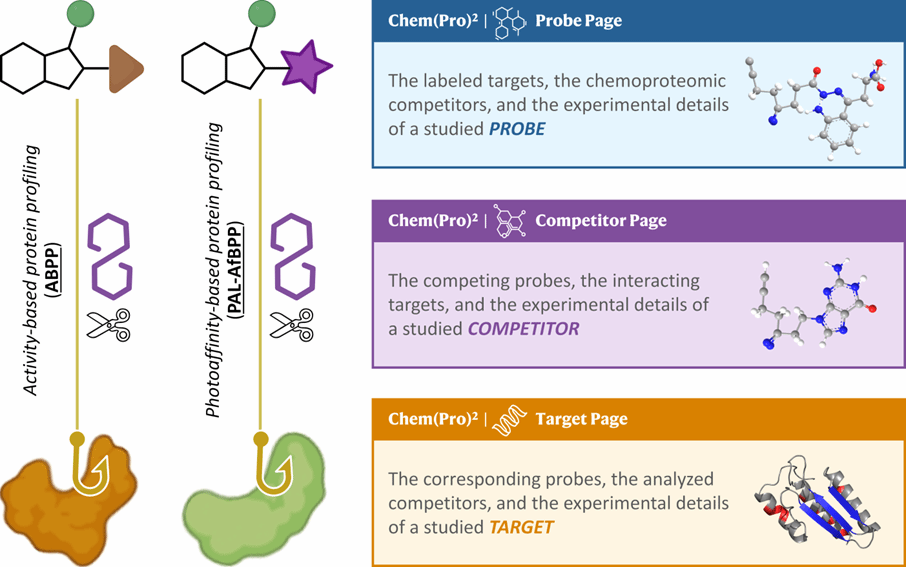
Figure 1. Relationships among the three key components (CPPs, competitors, and probe-labeled targets) in the Chem(Pro)² database. The left side shows two CPP-related technologies: Activity-Based Protein Profiling (ABPP) and Photoaffinity Labeling-based Activity-Based Protein Profiling (PAL-AfBPP). The right side displays the main content in different Chem(Pro)² pages (probe/competitor/target pages).
The Ningbo University Institute of Drug Discovery Technology is the first affiliated institution of the paper. Fu Songsen from Ningbo University and Chen Zhen from Zhejiang University are co-first authors, while Ni Feng from Ningbo University, and Zhu Feng and Yang Qingxia from Zhejiang University serve as co-corresponding authors. Luo Zhiming and Nie Meiyun from Ningbo Leader Biotech Co., Ltd., and Fu Tingting and Zhou Ying from Zhejiang University jointly participated in this work. This research was supported by the National Natural Science Foundation of China and the Ningbo Top Talent Program, among other projects.
Original Article Link:
Songsen Fu, Zhen Chen, Zhiming Luo, Meiyun Nie, Tingting Fu, Ying Zhou, Qingxia Yang, Feng Zhu, Feng Ni, Chem(Pro)2: the atlas of chemoproteomic probes labelling human proteins, Nucleic Acids Research, 2024; https://doi.org/10.1093/nar/gkae943

