(This article was AI-generated. Please contact us at liyanguo@nbu.edu.cn if you notice any errors)
Proteomics analysis serves as a core approach for decoding biological mechanisms, discovering disease biomarkers, and screening drug targets. As a critical step prior to mass spectrometry analysis, sample preparation directly determines the quality of research outcomes in terms of efficiency, sensitivity, and throughput—especially for precious samples that are low in quantity and non-amplifiable, such as clinical biopsies and primary cells. Traditional methods often face challenges such as long processing times, low sensitivity, and significant sample loss.
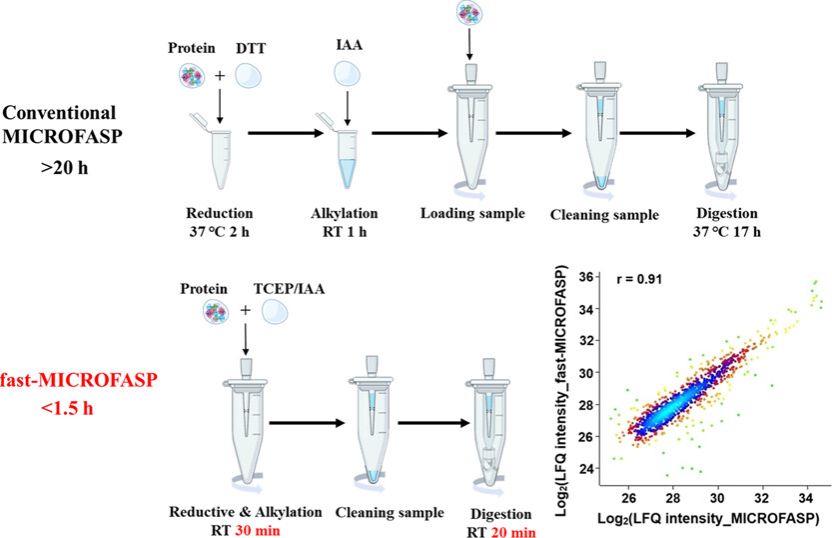
Recently, the team led by Zhenbin Zhang at Ningbo University developed a groundbreaking 96-well plate-based fast-MICROFASP technology, achieving a disruptive breakthrough. The entire workflow for microprotein sample preparation can be completed in just 1.5 hours, with sensitivity and reproducibility reaching industry-leading levels, injecting new momentum into high-throughput and high-precision proteomics research. While the traditional MICROFASP method offers high sensitivity, its sample preparation time exceeds 20 hours, making it difficult to meet the demands of large-scale sample analysis. Meanwhile, mainstream methods such as iST suffer from poor detergent compatibility and significant sample loss, limiting their ability to handle low-quantity samples. Through precise optimization of experimental parameters, the fast-MICROFASP technology achieves comprehensive improvements:
Ultra-Fast Efficiency: Time Reduction of Over 90%
This technology dramatically shortens the proteolytic digestion time from the traditional 17 hours to just 20 minutes, while integrating the reduction and alkylation steps into a single 30-minute in-situ reaction. The entire sample preparation workflow is reduced from "hours" to 1.5 hours, improving efficiency by more than 13-fold. The identification results remain highly consistent with traditional methods (protein label-free quantification LFQ intensity correlation coefficient r=0.91), and key metrics such as peptide miscleavage rate and alkylation efficiency meet industry benchmark levels.
Ultra-High Sensitivity: Enabling Deep Analysis of 1 μg Samples
For K562 cell lysate samples as low as 1 μg, fast-MICROFASP identifies over 6 times more proteins and 19 times more peptides compared to commercial iST methods. In the analysis of APP/PS1 transgenic mouse brain tissue, this technology accurately detected amyloid β-protein—closely associated with Alzheimer's disease—using only 1 μg of protein lysate, demonstrating its exceptional ability to capture low-abundance, disease-related proteins and offering potential for biomarker discovery in limited clinical samples.
High Throughput + High Reproducibility: Suitable for Large-Scale Studies
The high-throughput version, developed based on a 96-well plate, can process up to 192 samples in parallel. For eight mouse brain tissue samples, the relative standard deviation of proteome identification results was only 0.7%, with protein LFQ intensity correlation coefficients r>0.99, far exceeding the reproducibility and stability of comparable methods. This capability makes it highly efficient for supporting large-scale clinical cohort studies, drug screening, and other scenarios requiring batch sample processing.
Strong Compatibility: Minimizing Sample Loss
Unlike iST methods based on reverse-phase chromatography resins, fast-MICROFASP utilizes low molecular weight cut-off filter membrane technology, which is compatible with high concentrations of various detergents (e.g., SDS, NP-40). Sample purification can be completed without additional detergent removal, avoiding sample loss caused by multiple elution and dilution steps in traditional methods. This makes it particularly suitable for processing complex biological samples.
The emergence of fast-MICROFASP technology holds significant promise:
In clinical research, it enables efficient processing of microsamples such as biopsy tissues, cerebrospinal fluid, and single cells, aiding in the discovery of early diagnostic biomarkers for cancers and neurodegenerative diseases like Alzheimer's.
In basic research, it provides high-fidelity technical solutions for analyzing rare samples in fields such as neuroscience and developmental biology, including primary neurons and embryonic cells.
In drug development, it allows rapid large-scale proteomic screening of cell/tissue samples, accelerating drug target validation and mechanism-of-action studies.
In the future, this technology could be integrated with automated liquid handling platforms to further reduce manual labor costs, driving proteomics sample preparation toward "full automation, high throughput, and high sensitivity." This will make deep proteomic analysis of low-quantity samples faster, more accurate, and more accessible, opening new horizons for precision medicine and life sciences research.
This work was supported by the National Natural Science Foundation of China (Grant No. 22374084).
Full article link: https://pubs.acs.org/doi/10.1021/acs.analchem.4c04857

